


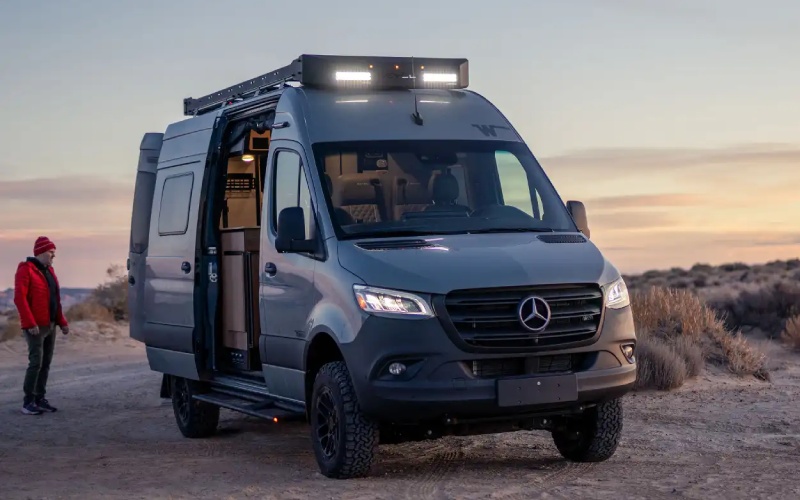
Winnebago Motor Homes - Which off-grid Class B is better for off-road camping around Madison, WI — the 2026 Winnebago Revel or the 2026 Jayco Terrain?
Shoppers comparing the 2026 Winnebago® Revel® and the 2026 Jayco Terrain for cold-weather boondocking want two things: reliable heat and predictable power. Both vans ride on the Mercedes-Benz® AWD Sprinter, but the way each manages electricity, water, and cabin warmth shapes day-to-day ease. The Revel leans into a factory-integrated power and climate strategy: hydronic heating with multi-zone control, a heated freshwater tank, a 210W solar array, and the Winnebago Power MAX 8.4kWh Lithionics® lithium system driven by the EcoFlow® Power Hub Pro. Terrain counters with the Timberline hydronic system, 200W solar, and a 48V-165Ah lithium package on select floor plans with a dedicated second alternator. In practice, both heat well; the Revel’s multi-zone control and heated fresh tank simply reduce manual work as temperatures swing, making it easier to stay longer with less system babysitting.
Off-grid electrical confidence is the other half of the story. The Revel’s EcoFlow® Power Hub Pro centralizes a 3,600-watt inverter, inverter charger, DC-DC converter, MPPT solar charger, and alternator charger under a single touchscreen and app-based interface, so you can see state of charge, charging source, and loads at a glance. Terrain’s 48V system is robust, particularly paired with the second alternator, but it disperses functions across components and offers 200W solar from the factory. If your winter weekends run laptops, induction cooking, and overnight heat, the Revel’s 8.4kWh pack with integrated dual-alternator charging adds notable cushion. For shoppers triangulating from the suburbs and trailheads, we’re serving Chicago, Madison, and Milwaukee with walk-throughs that map these differences to your itinerary.
- Heated water strategy: Revel includes a heated freshwater tank; Terrain places the fresh tank inside for protection but does not publish a heated-fresh spec.
- Solar baseline: Revel installs 210W from the factory; Terrain publishes 200W.
- Charging architecture: Revel integrates dual-alternator capability within EcoFlow®; Terrain lists a dedicated second 48V alternator on lithium-equipped floor plans.
- Shore connection: Revel uses a 30A SmartPlug® connector for a secure fit; Terrain uses a 30A detachable cord.
- Interior versatility: Revel’s RAM® Tough-Track™ mounts help stage work and storage; Terrain focuses mounting hardware in the rear garage L-tracks.
Storage and sleep are closer than they first appear. Both provide a power lift bed over a dedicated garage with L-track tie downs. Terrain’s bed is rated up to 750 pounds; Revel’s lift bed pairs with WinnSleep® technology and molded storage pockets. On the road, each benefits from Sprinter safety tech like DISTRONIC®, lane keeping assist, and LED headlamps. In camp, both include side and rear screen doors, induction cooking, and compact wet baths, with Terrain adding Aqua View® SHOWERMI$ER™ water-saving tech. If you expect frequent urban stopovers, the Revel’s optional digital rearview mirror and SmartPlug® shore connection add everyday ease alongside winter capability.
The short answer for Madison-area winter weekenders: if your priority is the simplest path to quiet, extended off-grid stays in cold conditions, the Revel’s multi-zone hydronic heat, heated freshwater tank, and EcoFlow®-integrated Power MAX system are a compelling combination. If you want an alternative power path with available generator options and are set on Starlink from the factory on specific layouts, Terrain remains a practical competitor. We recommend seeing both power screens live, checking garage tie-down points with your actual gear, and confirming how each bath and galley flow for your routine.
One final note on service and support: Winnebago Motor Homes offers orientation and follow-up that help you get the most out of modern lithium, solar, and hydronic systems—especially critical for winter boondocking where margins matter.
Frequently Asked Questions:
Can either van comfortably manage below-freezing overnights without hookups?
Yes, both use hydronic heating and are built on the insulated Sprinter. The Revel’s multi-zone control and heated freshwater tank simplify system management, while Terrain’s Timberline system and interior-mounted fresh tank provide solid protection. Planning for battery state of charge and ventilation remains important in either model.
What should I prioritize for repeat winter weekends?
Look for a heated fresh water strategy, integrated power management, and alternator-assisted charging. Verify factory solar wattage, review the inverter output relative to your appliances, and confirm how easily you can monitor system status on a single screen.